
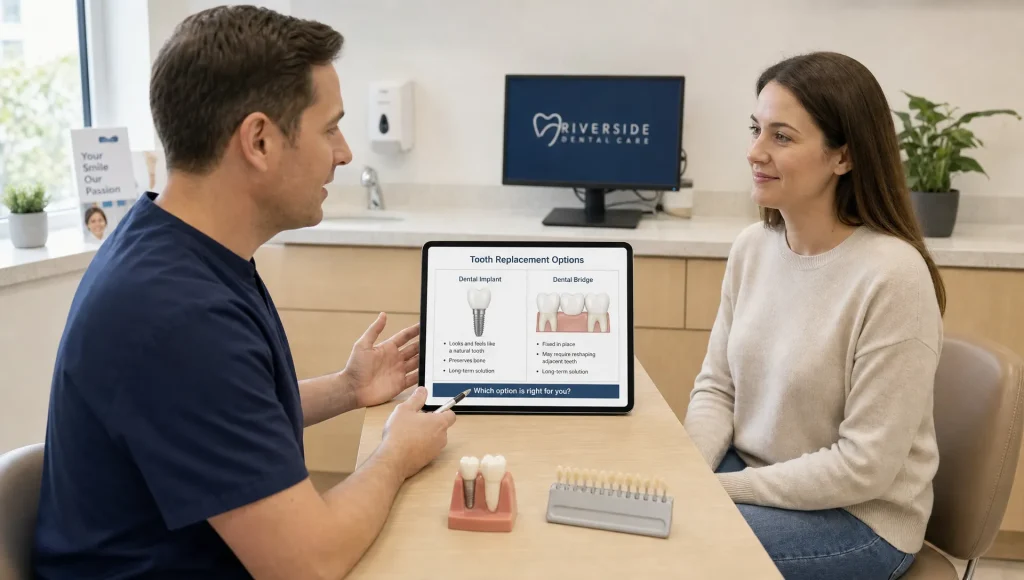
A missing tooth can affect how you chew, speak and smile, so the choice between an implant and a bridge deserves careful thought. Your decision should be based on your oral health, bone support, adjacent teeth, budget and the result you want to live with for years.
At West Malling Dental & Implant Centre, patients from West Malling, Kings Hill and across Kent can discuss tooth replacement in a relaxed setting. The practice currently offers new patient check-ups for £65, including an X-ray and a £45 dental implants consultation, which is a sensible first step if you want to understand whether implants, bridges or another option may suit you.
Dental implants vs bridges: the basic difference
A dental implant replaces the missing tooth root with a small titanium fixture placed into the jawbone. After healing, a crown, bridge or denture can be attached to it. The aim is to create a stable, fixed replacement that does not rely on neighbouring teeth for support.
A dental bridge replaces the visible part of the missing tooth by anchoring it to nearby teeth or, in some cases, to implants. A conventional bridge usually involves preparing the teeth either side of the gap for crowns. A resin-bonded bridge, sometimes called an adhesive bridge, uses a metal or ceramic wing bonded to the back of a neighbouring tooth and may be more conservative in selected cases.
Neither option is automatically better for everyone. The best choice depends on the condition of your mouth as a whole, not just the gap.
When dental implants may be the better option
Dental implants are often considered when you want a fixed replacement that feels secure and preserves the adjacent teeth. They can be especially suitable if the teeth either side of the gap are healthy and have not already been heavily filled or crowned.
Common implant options include a single tooth implant for one missing tooth, an implant-supported bridge for several missing teeth and implant-retained dentures for people who struggle with loose dentures. In some full-arch cases, a small number of implants can support a complete fixed bridge or stabilised denture, but this requires careful assessment and planning.
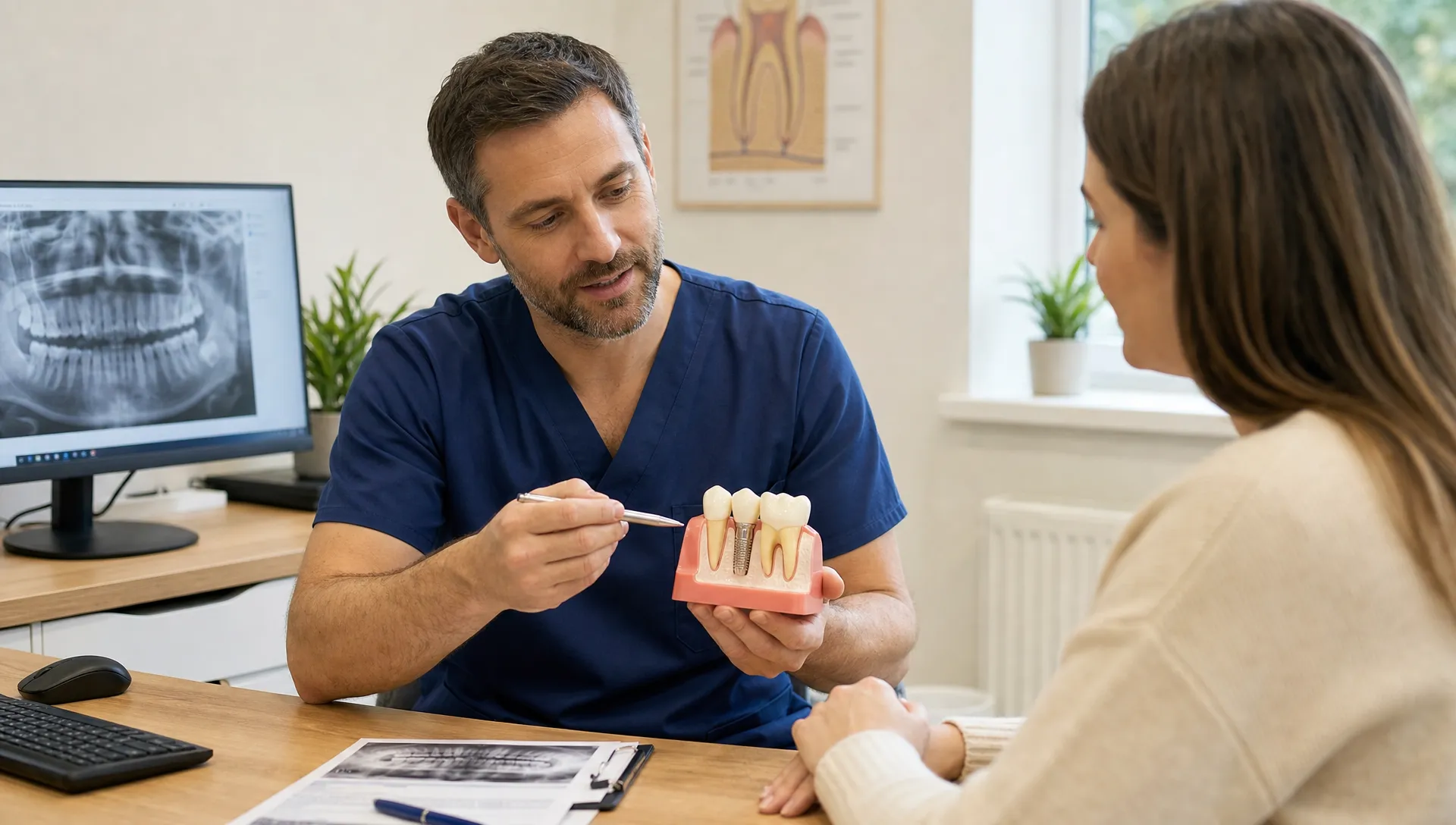
Preparation matters. Before placing an implant, your dentist needs to assess gum health, bone volume, bite forces, oral hygiene, medical history and any risk factors such as smoking or uncontrolled diabetes. X-rays are part of this process including 3D imaging where more detail is needed.
If bone has shrunk after tooth loss, a bone graft or sinus lift may be needed before or during implant treatment. This does not mean implants are impossible, but it can affect the timeline and complexity. You can learn more about the stages involved in the dental implant treatment journey
What a dental clinic private patients trust should assess
A dental clinic private patients trust should look beyond the missing tooth and assess how any new restoration will work with your bite, gums, smile line and future maintenance. This is one of the reasons implant planning is more involved than simply choosing a replacement tooth from a chart.
At West Malling Dental & Implant Centre, the focus is on helping patients protect their oral health while improving confidence in their smile. That means discussing benefits, limitations and alternatives clearly, including whether a bridge may be more appropriate than an implant.
| Factor | Dental implant | Dental bridge |
|---|---|---|
| Support | Jawbone | Neighbouring teeth or implants |
| Adjacent teeth | Usually not cut down | May need reshaping for crowns |
| Treatment time | Usually longer due to healing | Often faster |
| Bone preservation | Helps maintain bone around the implant | Does not replace the tooth root |
| Maintenance | Needs excellent cleaning around implant and crown | Needs cleaning under the bridge and around supporting teeth |
| Suitability | Depends on bone, gum health and medical factors | Depends on strength of supporting teeth |
When a bridge may be the better option
A bridge may suit you if the teeth beside the gap already need crowns or have large restorations. In that situation, using those teeth to support a bridge can sometimes be practical because they already require restorative treatment.
A bridge may also be considered if implant surgery is not suitable for medical reasons, if there is not enough bone and grafting is not desired or if you prefer a shorter treatment timeline. Some patients also choose a bridge because they want to avoid surgery altogether.
There are trade-offs. A conventional bridge places extra load on the supporting teeth and can make cleaning more demanding. If one supporting tooth develops decay, gum problems or root issues later, the whole bridge may be affected. A resin-bonded bridge can be less invasive, but it is not suitable for every bite or every position in the mouth.
Preparing for successful dental implant treatment
Good preparation improves the chance of a stable, attractive result. A dental clinic private patients return to over time will usually start by making sure the mouth is healthy enough for treatment, rather than rushing straight to implant placement.
Your preparation may include a hygiene appointment, treatment for gum disease, removal of failing teeth, temporary tooth replacement and a review of any medicines or medical conditions. If you grind your teeth, your dentist may discuss bite protection because excessive force can affect implants, crowns and bridges.
Planning the final tooth is just as important as placing the implant. The implant position must support the shape, colour and emergence profile of the future crown. For front teeth, aesthetics can be particularly delicate because the gum line, tooth shade and symmetry are all visible when you smile.
Longevity and aftercare: what to expect
Both implants and bridges need regular maintenance. An implant cannot decay like a natural tooth, but the gum and bone around it can still become inflamed if plaque builds up. A bridge can be long-lasting too, but the supporting teeth remain vulnerable to decay and gum disease.
Daily cleaning is essential. For implants, this may involve interdental brushes, floss or water flossing around the crown and gum margin. For bridges, you need to clean underneath the false tooth and around the supporting teeth. Hygienist care, including Airflow where appropriate, can help keep plaque and staining under control.
The long-term value of any tooth replacement depends on planning, home care and ongoing reviews. For a deeper look at implant lifespan, read West Malling Dental’s guide to how long dental implants last.
How to choose between implants and bridges
The decision is usually clearest after a proper examination. If the neighbouring teeth are healthy, an implant may be attractive because it avoids cutting them down. If the neighbouring teeth already need crowns, a bridge may be a sensible restorative choice. If multiple teeth are missing, implant-supported options may provide better stability than a longer tooth-supported bridge.
Cost also matters, but it should be considered alongside lifespan, future maintenance and the risk of needing further treatment. The cheapest option at the start is not always the best value if it compromises healthy teeth or needs replacing sooner than expected.
West Malling Dental & Implant Centre offers family, preventive, cosmetic and emergency dental care in one private practice, with same-day emergency appointments where available. If you are unsure what to do about a missing tooth, the current £45 dental implants consultation gives you a clear starting point without committing to treatment before you understand your options.
Frequently asked questions
Is a dental implant better than a bridge? Not always. An implant may be better when the neighbouring teeth are healthy and there is enough bone support. A bridge may be better when adjacent teeth already need crowns or when surgery is not suitable.
Is implant treatment painful? Implant placement is usually carried out with local anaesthetic. You may feel pressure during treatment and some soreness afterwards, but your dentist will explain pain relief and aftercare before you leave.
How long does a dental bridge take compared with an implant? A bridge is often completed more quickly because it does not usually require a healing period in the jawbone. Implant treatment takes longer because the implant needs time to integrate before the final crown or bridge is fitted.
Can I have an implant if I have gum disease? Gum disease needs to be stabilised before implant treatment. A dental clinic private patients trust will usually recommend improving gum health first because healthy gums and bone are vital for long-term success.
What if I need a tooth replaced urgently? Contact the practice as soon as possible. West Malling Dental & Implant Centre offers emergency same-day care where available and can discuss temporary options while your long-term treatment is planned.
Book a missing tooth consultation in West Malling
If you want a dental implants specialist in Kent you can rely on for clear advice, West Malling Dental & Implant Centre can help you compare implants and bridges without pressure. Book an assessment, currently £45 and take the first step towards a stronger, more confident smile.