Dental implants can be life changing when they are planned and maintained well. They can restore chewing confidence, protect neighbouring teeth, and help you smile without feeling self-conscious about a missing tooth. But implants are also a long term clinical investment, so choosing the right dental implant clinic matters just as much as choosing the treatment itself.
If you have searched for a “dental implant clinic near me”, you have probably seen a wide range of prices, promises, and before and after photos. The best choice is not always the closest clinic or the cheapest quote. It is the clinic that can assess your mouth properly, explain your options clearly, manage risk, and support you after the implant has been fitted.
This guide explains what to look for before you book, what questions to ask, and which warning signs should make you pause.
Start with professional registration and accountability
In the UK, any dentist providing care must be registered with the General Dental Council. You can search the GDC register to confirm a dentist’s registration status and whether there are any restrictions on their practice.
It is also worth checking that the practice is registered with the Care Quality Commission, which regulates health and social care services in England, including dental practices. CQC registration does not tell you whether a dentist is the “best” implant dentist, but it does confirm that the provider is operating within a regulated healthcare environment.
One important point: implant dentistry is not a GDC specialist list in the same way that orthodontics or periodontics are recognised specialties. That means the words “implant dentist” or “implant clinic” can cover a wide range of training and experience. A good clinic should be comfortable discussing the clinician’s implant training, experience, planning process, and approach to complications.
Ask who will be responsible for each stage of your care. In some practices, one dentist places the implant and another restores it with the crown or bridge. That can work very well, but only when the team communicates clearly and plans the case together from the start.
Expect a proper assessment, not a quick quote
A dental implant is not simply a screw placed where a tooth used to be. It has to work with your gums, bone, bite, smile line, medical history, and future oral hygiene. That is why a trustworthy implant clinic should begin with a detailed assessment rather than a rushed sales conversation.
A good implant assessment will usually consider your gum health, remaining teeth, bone volume, bite forces, smoking status, medical conditions, medications, and expectations. The dentist should also explain whether you need any treatment before the implant, such as hygiene care, gum treatment, extraction planning, or bone grafting.
Many implant cases also require three dimensional imaging. A Cone Beam CT scan can help the dentist assess bone height and width, locate nerves and sinuses, and plan the safest implant position. If you want to understand this step in more detail, West Malling Dental explains why a CT scan of your jaw may be needed before dental implants.
| What the clinic should assess | Why it matters |
|---|---|
| Gum health | Gum disease can increase the risk of implant complications and bone loss. |
| Bone volume and density | The implant needs enough stable bone to support it safely. |
| Bite and grinding habits | Heavy bite forces can affect the implant crown, screws, and surrounding teeth. |
| Medical history and medication | Conditions such as diabetes or certain medicines may affect healing and planning. |
| Smile line and aesthetics | Front tooth implants need careful planning for gum shape, shade, and symmetry. |
| Oral hygiene routine | Long term maintenance is essential for implant health. |
If a clinic offers a final price before examining your mouth properly, treat that as an estimate at best. Until your dentist has assessed the clinical picture, they cannot know exactly what your case requires.
Look for planning that starts with the final tooth
The right implant clinic should not start by asking, “Where can we place the implant?” It should start by asking, “Where does the final tooth need to be?”
This is a key difference. The best implant position is guided by the final crown, bridge, or denture. If an implant is placed in a position that is surgically convenient but restoratively awkward, the final tooth may look bulky, be difficult to clean, or place too much stress on the implant.
For front teeth, the aesthetic planning is even more important. The dentist may need to consider gum contours, tooth shade, translucency, tooth length, and how the new tooth will sit next to natural teeth. In complex aesthetic cases, collaboration with a skilled dental technician can make a noticeable difference.
This principle applies across many areas of elective healthcare. Whether someone is comparing dental implant providers or researching clinician-led cosmetic and wellness treatments, the safest decisions usually come from looking beyond marketing claims and asking who plans the treatment, how risks are managed, and what follow-up support is available.
Compare costs carefully, but do not choose on price alone
Dental implant fees can vary because cases vary. A straightforward single implant is very different from a case involving extractions, bone grafting, sinus work, temporary teeth, multiple implants, or full arch restoration.
When comparing quotes, make sure you know what is included. A low headline price may not include the consultation, CT scan, abutment, crown, temporary restoration, bone graft, review appointments, or maintenance visits. The cheapest option can become more expensive if important steps are added later or if problems need correcting.
A transparent clinic should provide an itemised treatment plan and explain possible additional costs before you commit. If you are researching local fees, this guide to how much dental implants cost in Kent can help you understand the factors that influence pricing.
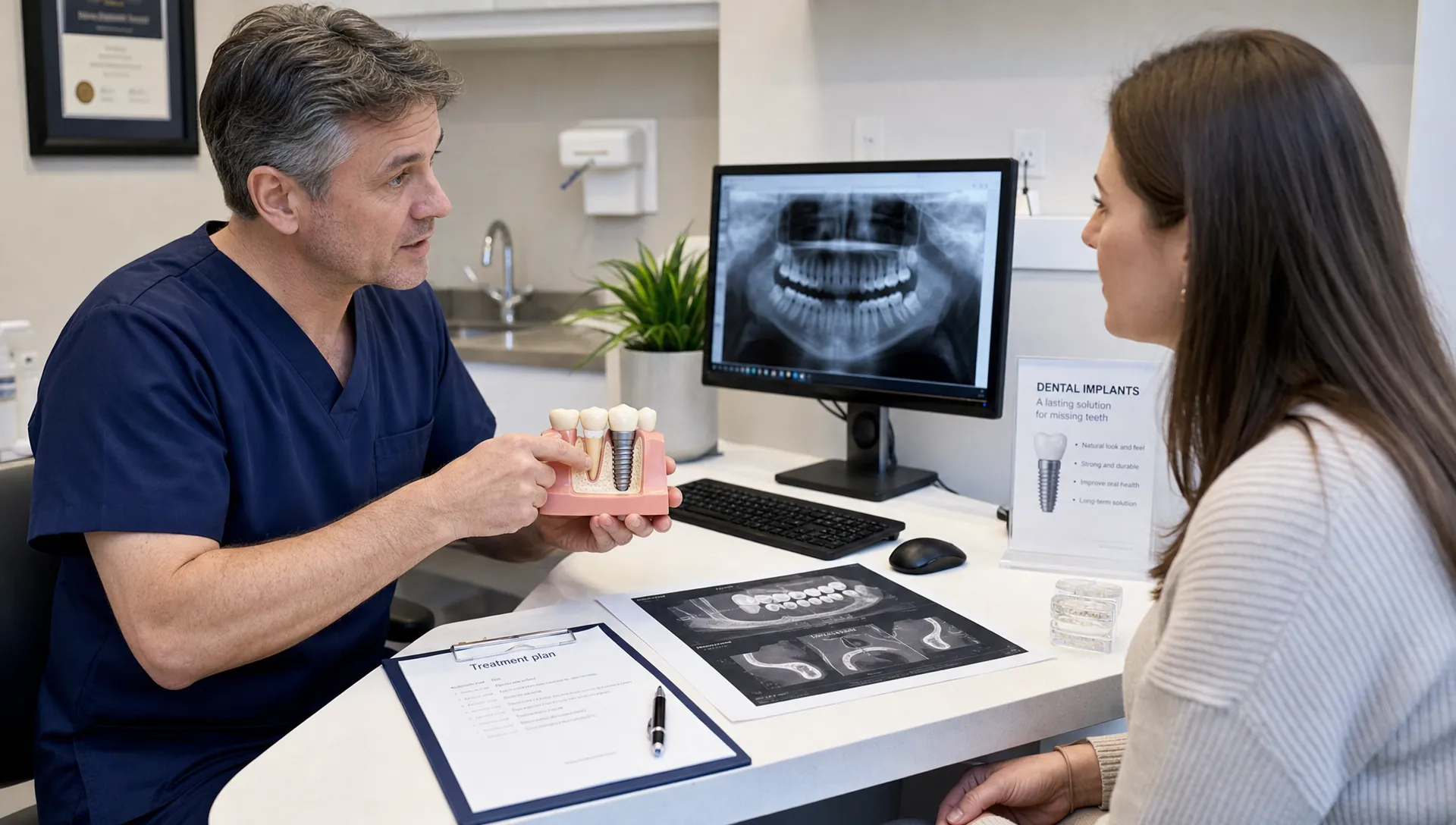
A good value implant clinic is not necessarily the lowest priced clinic. It is the one that gives you a safe, well planned, maintainable result with clear communication and appropriate aftercare.
Prioritise aftercare and long term maintenance
Dental implants are often described as a long term solution, but they are not a fit and forget treatment. Like natural teeth, they need careful cleaning and regular professional review.
The gum and bone around implants can develop inflammation if plaque builds up. Early inflammation may be reversible, but more advanced disease around implants can cause bone loss and threaten the implant. This is one reason why hygienist support matters so much.
When choosing a clinic, ask what happens after the implant is fitted. Will there be review appointments? How often should the implant be checked? Will the hygienist show you how to clean around the implant crown or bridge? What should you do if the crown feels loose, the gum becomes sore, or you notice bleeding?
Local access is a practical advantage. If your implant clinic is near your home or workplace, it is much easier to attend reviews and seek help promptly if something feels wrong. This is especially important if you are considering travelling far away for treatment, where aftercare may be limited or difficult to arrange.
Ask how the clinic manages risks and complications
No ethical implant clinic should promise a guaranteed perfect outcome. Dental implants have a strong track record, but every surgical treatment carries risks. These can include infection, delayed healing, implant failure, nerve injury, sinus complications, aesthetic compromise, gum recession, and mechanical problems such as screw loosening or crown fracture.
The right clinic will not try to scare you, but it will be honest. It should explain the risks that apply to your specific case and discuss what can be done to reduce them.
Pay attention to how the dentist responds when you ask about complications. A confident, patient-centred clinician will answer openly and explain the plan. A poor clinic may dismiss your concerns, pressure you to decide quickly, or focus only on success stories.
You should also ask whether the same practice can help if something needs adjusting later. Implant care does not end when the crown is fitted. Long term support is part of the treatment.
Consider comfort, communication, and trust
The clinical details matter, but so does how you feel during the consultation. Dental implant treatment can involve several appointments, so you need a team that communicates clearly and puts you at ease.
Good communication includes explaining options in plain English, checking that you understand the proposed treatment, and giving you time to make a decision. You should not feel rushed or embarrassed for asking questions. If you are nervous, the clinic should take your concerns seriously and discuss ways to make treatment more comfortable.
It is also worth noticing whether the dentist talks about alternatives. Implants are excellent for many patients, but they are not the only option. Depending on your mouth, a bridge, denture, orthodontic space closure, or no treatment may also be discussed. A trustworthy dentist will help you compare realistic options rather than pushing one treatment.
Warning signs when choosing an implant clinic
Some red flags are obvious, but others are more subtle. Be cautious if you notice any of the following:
- You are given a fixed quote without a proper examination or scan.
- The clinic cannot explain who will place and restore the implant.
- You feel pressured by limited time discounts or high pressure sales tactics.
- The dentist does not discuss gum health, bone volume, or bite forces.
- The treatment plan is vague about what is included in the fee.
- There is little information about aftercare, maintenance, or complication management.
- The clinic focuses heavily on speed but says little about healing, safety, or review appointments.
- You are promised a guaranteed result without a balanced discussion of risk.
If something feels unclear, ask for more information in writing. A reputable clinic should welcome informed patients.
Questions to ask before you choose
You do not need to arrive at your consultation with medical knowledge. You only need to ask practical questions that reveal how carefully the clinic works.
| Question to ask | What a good answer should cover |
|---|---|
| Am I suitable for implants? | Gum health, bone levels, medical history, smoking, bite, and alternatives. |
| Do I need a CT scan? | Why three dimensional imaging is or is not needed for your case. |
| Who will place the implant and who will fit the crown? | The clinician’s role, experience, and how the team coordinates planning. |
| What exactly is included in the fee? | Consultation, scans, implant, abutment, crown, temporary teeth, reviews, and possible extras. |
| What are the main risks in my case? | A personalised explanation rather than a generic reassurance. |
| How will I care for the implant afterwards? | Hygiene advice, review schedule, professional cleaning, and warning signs. |
| What happens if there is a problem? | Access to support, repair pathways, and how complications are managed. |
These questions help you compare clinics on quality rather than marketing alone.
Why local experience matters when searching for a dental implant clinic near me
Searching locally is not just about convenience. A nearby implant clinic can make assessment, surgery, restoration, and aftercare smoother. You can attend hygiene appointments more easily, book reviews without major travel, and get help promptly if something feels uncomfortable.
For patients in West Malling, Kings Hill, and surrounding Kent villages, a local private practice can also support the wider picture of oral health. That matters because dental implants work best in a healthy mouth. Preventive care, hygiene visits, emergency access, cosmetic planning, and family dentistry can all contribute to keeping your implant and natural teeth stable over time.
West Malling Dental & Implant Centre provides private dental care in a relaxed setting, including dental implants, new patient check-ups, hygienist care with Airflow, cosmetic dentistry, Invisalign, teeth whitening, bonding, crowns, veneers, family dentistry, and same-day emergency care where available. If you are considering implants, the most useful first step is a thorough examination and a clear conversation about your options.
Frequently Asked Questions
How do I know if a dental implant clinic is reputable? Check that the dentist is registered with the GDC and that the practice is regulated by the CQC. Then look for evidence of proper assessment, clear treatment planning, transparent fees, and long term aftercare.
Should I choose the cheapest dental implant clinic? Not usually. A low price may exclude important items such as scans, the final crown, temporary teeth, grafting, or review appointments. Focus on what is included, how the case is planned, and how complications are managed.
Do I always need a CT scan before dental implants? Not always, but many cases benefit from CBCT imaging because it shows the jaw in three dimensions. Your dentist should explain whether it is clinically necessary for your case.
Is it better to choose a dental implant clinic near me? Local care can be a major advantage because implants need reviews and maintenance. A nearby clinic makes it easier to attend appointments and get support quickly if something changes.
Can any dentist provide dental implants? Dentists can provide implants if they have appropriate training and experience, but implant dentistry is not a GDC specialty. Ask about the clinician’s training, planning process, and experience with cases like yours.
What should happen at a first implant consultation? The dentist should assess your mouth, discuss your medical history, examine your gums and bite, consider imaging, explain alternatives, outline risks, and provide a clear written treatment plan if implants are suitable.
Ready to explore dental implants in Kent?
Choosing the right dental implant clinic is about trust, planning, and support. Look for a team that takes time to assess your mouth properly, explains your options clearly, and stays involved after treatment is complete.
If you are based in West Malling, Kings Hill, or the surrounding Kent area, West Malling Dental & Implant Centre can help you understand whether dental implants are suitable for you and what your next steps may involve. Book a consultation to get personalised advice before making a decision.